



The Strategic Engine: The Role of Research and Development (R&D) in Business Growth and Innovation

1. Introduction: The Imperative of Innovation in a Globalized Economy
In the hyper-competitive landscape of the 21st century, the traditional boundaries of business have dissolved. Companies no longer compete merely with local rivals but with global entities capable of rapid technological disruption. Within this context, Research and Development (R&D) has transitioned from a backend technical function to the primary driver of corporate strategy and national economic resilience.
For high-stakes sectors—including industrial manufacturing, laboratory infrastructure, and specialized engineering—R&D is the “insurance policy” for the future. According to the World Bank, firms that consistently invest in R&D are not only more productive but are also significantly better equipped to navigate macro-economic shocks. In Egypt, this reality is underscored by the national “Vision 2030” and the Ministry of Planning’s recent data, which shows a 14.5% growth in non-oil manufacturing as the country pivots toward high-productivity, value-added sectors. For a group like ISG | Integrated Scientific Group, R&D is the mechanism that transforms local manufacturing into world-class engineering.
2. Defining R&D: The Three Pillars of Progress
To understand the impact of R&D, one must first demystify its core components. R&D is not a singular activity but a spectrum of exploration:
- Basic Research: The quest for fundamental knowledge. While it may not yield a product tomorrow, it builds the theoretical foundation for future breakthroughs (e.g., studying the molecular behavior of advanced polymers).
- Applied Research: Research directed toward a specific, practical objective. This involves taking fundamental knowledge and applying it to solve a concrete problem, such as developing a new coating that makes laboratory furniture resistant to highly volatile acids.
- Experimental Development: The final bridge to the market. This is the systematic work of using research to create new products or improve existing ones—turning a validated “proof of concept” into a scalable manufacturing process.
In technical sectors, R&D is the “bridge” between a conceptual scientific need and a physical, validated solution.
3. The Multi-Dimensional Benefits of R&D
The Return on Investment (ROI) for R&D is often viewed through the lens of “new products,” but its benefits are far more pervasive:
A. Sustainable Competitive Advantage
R&D allows a company to build a “moat” around its business. Through proprietary designs, unique material formulations, and patented processes, a company ensures that it cannot be easily undercut by low-cost, low-quality competitors.
B. Enhanced Operational Efficiency & Cost Reduction
Innovation is often internal. Process R&D focuses on “how” things are built. By optimizing manufacturing workflows—such as using automated CNC precision in metal fabrication for lab cabinets—companies can reduce waste by up to 20% and improve throughput, directly impacting the bottom line (McKinsey, 2024).
C. Regulatory Compliance and Safety
In the scientific and medical fields, compliance is non-negotiable. R&D teams ensure that products meet or exceed international standards like ISO, SEFA (Scientific Equipment and Furniture Association), and EN (European Norms). This proactive approach prevents the catastrophic costs of product recalls or project failures in sensitive environments like hospitals or pharmaceutical labs.
D. Talent Attraction and Retention
Top-tier engineers and scientists want to work for organizations that are at the “bleeding edge” of their fields. A robust R&D culture signals to the market that a company is a leader, not a follower, helping to bridge the “talent gap” often found in emerging markets.
4. The Role of R&D in Industrial and Technical Sectors
Industrial R&D differs from software R&D because it must contend with the laws of physics. It involves rigorous stress testing, thermal dynamics analysis, and environmental durability assessments.
Recent reports from WIPO (2025) indicate that ICT Hardware and Electrical Equipment sectors continue to lead global R&D spending. This is because the physical infrastructure of our world—the grids, the labs, and the factories—requires constant iteration to handle higher loads, smarter data integration, and lower energy consumption. In the Middle East, the push toward “Industry 4.0” is driving a surge in R&D focused on IoT-enabled manufacturing and smart infrastructure.
5. Dedicated Focus: Specialized R&D in Scientific Environments
For companies like Arias Egypt and others within the ISG umbrella, R&D is a high-precision discipline tailored to specific, demanding environments.
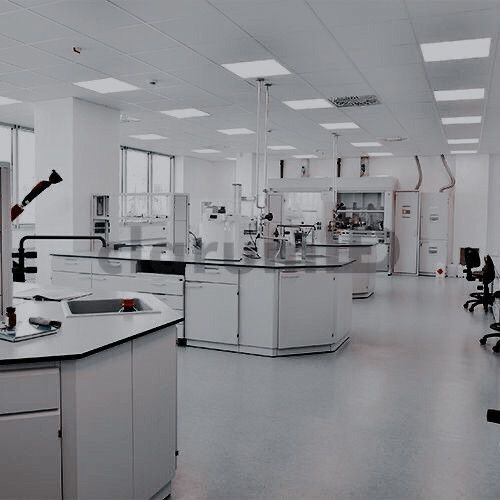
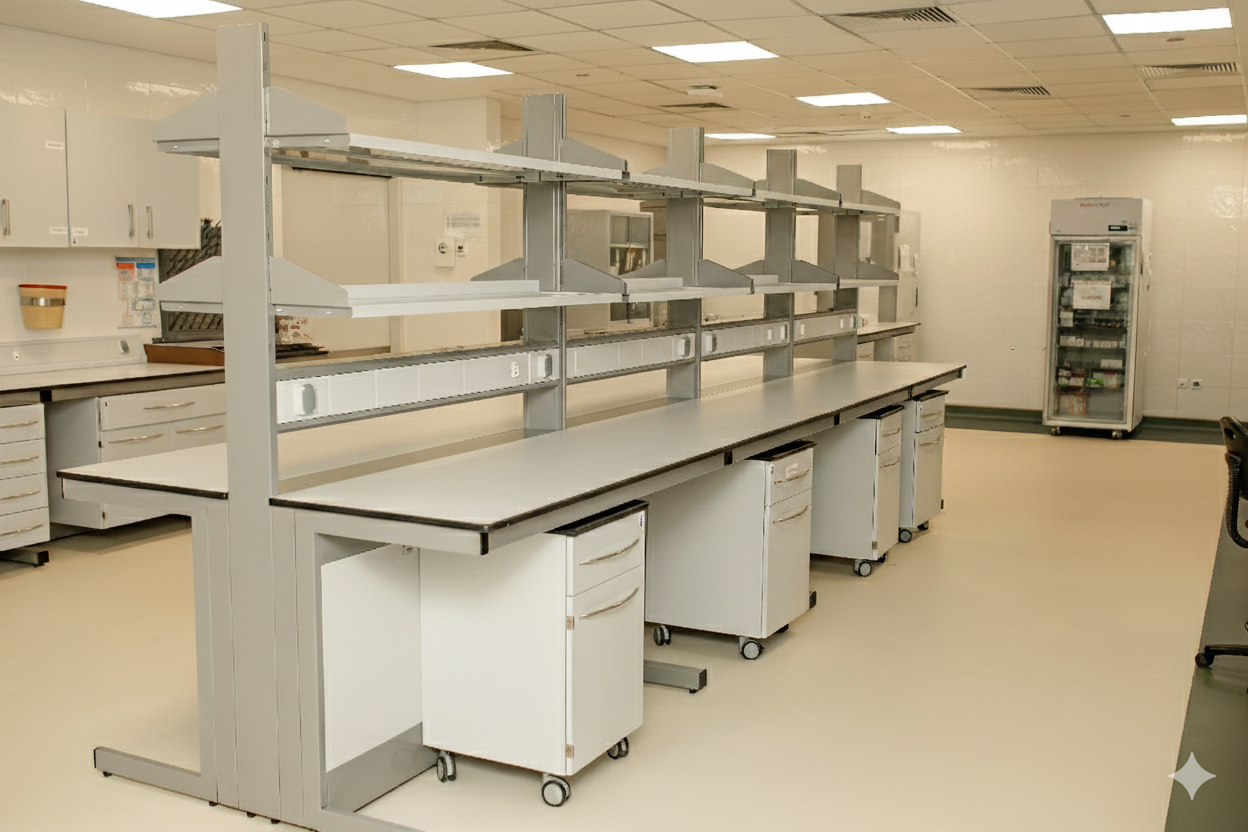
A. Laboratory Furniture & Storage Systems
- Material Science: Developing worktops (like Trespa or Epoxy resin) that can survive extreme thermal shock and chemical spills without degrading.
- Ergonomics: Creating height-adjustable, modular workstations that reduce researcher fatigue and allow for “plug-and-play” reconfigurability as research needs change.
- Fume Hood Technology: Using Computational Fluid Dynamics (CFD) to ensure that hazardous vapors are contained and exhausted with 99.9% efficiency while minimizing energy consumption.
B. Clean Rooms and Controlled Environments
- HEPA/ULPA Filtration: Designing systems that maintain ISO 5 or ISO 7 air purity.
- Pressure Differentials: Engineering “cascading pressure” zones to ensure that contaminants from a corridor never enter a sterile pharmaceutical production area.
- Modular Construction: R&D into prefabricated clean room panels that can be installed 50% faster than traditional methods.
C. Engineering Kits & Technical Education
Designing engineering kits that simulate real-world industrial problems—such as smart grid management or robotic automation—allowing students to learn on equipment that mirrors the actual “shop floor.”
6. Real-World Success: R&D as a Growth Catalyst
- Case Study: 3M’s 15% Rule: This culture led to the creation of the Post-it Note and thousands of industrial adhesives.
- The Egyptian Context: Local firms invested in “Green Hydrogen” or advanced medical manufacturing have recently secured over $2 billion in foreign direct investment (FDI).
7. Navigating the Challenges of R&D Implementation
- High Capital Intensity: R&D requires “patient capital” where rewards take years to materialize.
- Market Misalignment: The “ivory tower” problem where solutions are created for non-existent problems.
- Intellectual Property (IP) Risks: Protecting innovation from “copycats” requires a sophisticated legal framework.
8. Best Practices for a Robust R&D Strategy
- Customer-Centric Innovation: Start with the “pain points” of the end-user and work backward.
- Agile Prototyping: Use 3D printing and digital simulations before investing in expensive tooling.
- Strategic Partnerships: Collaborate with institutions like the ASRT or regional universities.
- Cross-Functional Teams: Ensure Marketing, Manufacturing, and R&D are in constant communication.
9. Future Trends: The “Smart” and “Green” Revolution
- AI and Automation: Generative AI for designing aerodynamic fume hoods and efficient layouts.
- The “Green Lab” Movement: Sustainable materials and low-energy HVAC systems are now requirements.
- Smart Labs (IoT): Connected furniture that monitors chemical levels and safety in real-time.
10. Conclusion: Evolving Beyond Boundaries
Research and Development is the difference between a company that survives and a company that leads. For the Middle East and Egypt, the transition from being “importers of technology” to “architects of innovation” is well underway. By investing in the systematic pursuit of knowledge, businesses build the infrastructure of the future.
Strategic Positioning: ISG | Integrated Scientific Group
ISG | Integrated Scientific Group embodies the spirit of R&D-driven growth. As a leading Egyptian holding group, ISG provides a holistic ecosystem of industrial and scientific solutions.
Through subsidiaries like Arias Egypt, the group has mastered the art of “Value-Added Manufacturing”—combining local Egyptian craftsmanship with global R&D standards. Whether it is a state-of-the-art Clean Room, a customized Fume Hood, or Engineering Kits, ISG delivers high-performance solutions. We don’t just supply equipment; we engineer the environments where the future is discovered.
References (APA Format)
- EY Switzerland. (2025). Companies worldwide increase their spending on Research and Development. Link
- Harvard Business Review. (2023). The Innovation Crisis: How to Rebuild Your R&D Pipeline.
- McKinsey & Company. (2024). Using AI to supercharge R&D.
- Ministry of Planning and Economic Development, Egypt. (2025). The Quarterly GDP Note.
- OECD. (2024). Main Science and Technology Indicators.
- WIPO. (2025). Global Innovation Index 2025. Link
- World Bank. (2024). Research and Development Expenditure (% of GDP) – MENA Region.